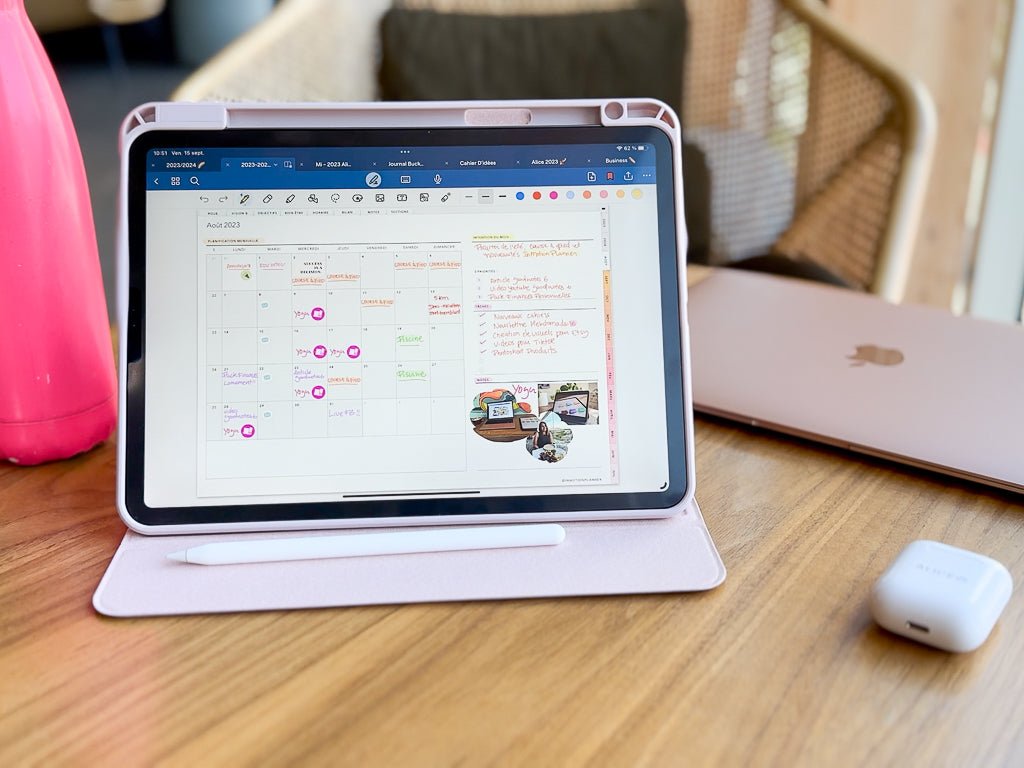
The Life Coach Planner is InMotion Planner's most comprehensive planner: designed to go beyond time management, with space to reflect on your priorities and track your life goals.
This article guides you through getting started, whether you've already purchased it or are still considering. I create my planners like traditional stationery, but in digital format, designed to be used on a tablet with a note-taking app and a stylus. If you're new to digital planning, our comprehensive guide and our introduction to compatible apps cover the basics in detail. Here's everything the Life Coach Planner contains, and how to get the most out of it.
What the Life Coach Planner contains
1. Reflection and personal development
The starting point of the planner is the Wheel of Life: a diagram that divides your life into 8 areas, in 4 main sections, to assess where you are and identify what needs more attention. This section is called Life Projects in the planner, and it's from this reflection that you define an annual vision and objectives for each area.
- Professional life (Work & Career, Money & Finances): your career goals, the steps to achieve them, and tracking your personal finances.
- Creative life (Physical Environment, Pleasures & Hobbies): arranging your living space and the time you dedicate to what makes you feel good outside of work.
- Social and love life (Family & Friends, Couple & Love): the time you set aside for your loved ones, with family, friends, or your partner.
- Development and well-being (Personal Growth, Health & Vitality): your learning, your physical and mental health, and the habits that help you progress.
What truly distinguishes this planner is that each area then gets its own space for reflection. For each of the 8 areas, a first page poses a series of targeted questions (your vision, your main objectives, your strengths, your challenges, your action plan in three deadlines, how you measure progress), a second Vision Board page lets you visualize this area with images and keywords, and a third page gives you a tool adapted to its nature: a budget table for finances, a birthday and event tracker for family and friends, a progress tracker for career, and so on depending on the area.
It's almost a complete coaching process, applied to each of the 8 areas of your life, rather than just a simple list of objectives.
2. Monthly Planning
Each month opens with a classic monthly calendar, followed by 5 pages to reflect before diving into the month.
- Objectives: an objective, an action plan, and a source of inspiration for each of the 4 sections of the Wheel of Life (professional life, creative, social and love life, personal).
- Vision Board: a space to visualize your monthly objectives with images and keywords. Read our complete guide to creating a successful Vision Board.
- Tasks: an Eisenhower matrix to sort your monthly tasks into to do, to schedule, to delegate, and to abandon.
- Notes: a free space for anything that doesn't fit elsewhere.
- Review: your highlights, a re-evaluation of your 8 life areas out of 10, a day-by-day habit tracker, your accomplishments, your challenges, and ongoing tasks not to lose sight of.
3. Weekly Planning
Three distinct weekly pages, to choose from depending on what your week needs.
- Weekly Overview: your important and urgent tasks, distributed day by day.
- Weekly Schedule: the whole week at a glance, with a complete hourly grid from Monday to Sunday.
- Weekly Notes: a dedicated space for each day for anything that doesn't fit elsewhere.
4. Daily Planning
Each day has its Schedule page: an hour-by-hour grid from 6 AM to 11 PM, with 4 parallel task categories (Work/Money, Home/Hobbies, Family/Friends, Growth/Well-being) to maintain an overview between your schedule and your priorities by area.
No need to fill everything out
The Life Coach Planner has 764 pages, which might give the impression that you need to fill everything out to benefit from it. That's not the case.
All navigation is done via hyperlinks: the side tabs (Year, Month, Sections) and quick links on each page take you directly where you need to be, without ever having to scroll through hundreds of pages in between. If you only use the Weekly Schedule and never the Weekly Notes, you click on the one you need each week and ignore the rest.
It's the same logic for the 8 life areas or the 5 monthly pages: you choose those that meet a real need, not all of them out of obligation. A comprehensive planner is a library of tools at your disposal, not a list of homework.
The different files
Upon purchase, you receive 6 PDF files: 3 versions of the planner, each available in 2 color palettes.
The 3 versions
- Style 1: daily pages with structured schedule, ideal for time-blocking.
- Style 2: more flexible daily pages, designed for tasks and daily notes rather than a fixed schedule.
- Without daily pages: for those who prefer to organize their daily life solely with weekly pages.
The 2 color palettes
Each version is available in a black and white palette with bright color accents, or an rainbow palette. The content of the pages remains identical, only the tabs and accents change.
You choose the combination of version and palette that best suits your planning style, without having to open all 6 files to compare.
How to fill in the dates
The planner is undated: no dates are pre-filled, which means it works for any year, indefinitely. You fill in the dates yourself, starting from the general to the specific.
Everything starts with the annual calendar, at the very beginning of the planner: you annotate it once with the key dates of the year. You then do the same for each monthly calendar, once a month. Since a month can cover up to 5 weeks depending on the year, each monthly calendar is hyperlinked to 5 weeks from the start, to cover all possible variations without ever running out of space.
Once the monthly dates are entered, you click directly from the calendar to the corresponding week, then to each day, and you enter the date on these pages as the week progresses. Navigation thus goes from the general to the specific: year, then month, then week, then day, without ever going back to search for a page.
The advantage of this system is its durability. You keep an original, blank copy in your files, and you duplicate it each new year to start over with updated dates. No need to wait or buy an annual update, your planner remains usable year after year.
How to get started
1. Choose your cover. The planner includes 10 cover pages. Drag your favorite to the beginning of your file in Goodnotes or your note-taking app.
2. Explore the structure. Before writing anything, browse the side tabs (Year, Month, Sections) to locate where each type of page is. This prevents searching while you're working.
3. Enter your dates. Follow the method described above: annual calendar, then monthly, then weekly and daily as the weeks progress.
4. Complete your Life Projects. Before diving into the first month, fill out the Life Projects section as best you can: Wheel of Life, reflection and objectives by area. This is what feeds your monthly objectives thereafter.
5. Start with your first month. Once your Life Projects are in place, launch your first month: monthly objectives, then the first week. The rest follows naturally, month after month.
Tips
The most important thing after preparing your planner is to refer to it regularly.
Personally, I check my planner 3 times a day. You'll find your own rhythm, but here's how I do it.
In the morning: I start with my daily page, my focus for the day, a gratitude, then my tasks and my schedule. I also plan time for physical activity or a moment of well-being.
Early afternoon: After lunch, before returning to work, I take a few minutes to check that I am following my daily plan and check off what has been done.
In the evening: I check off the rest of my completed tasks and reflect on my mood of the day, before giving it a rating. Unfinished tasks are moved to the next day, and I already plan a few things for the next day to start on the right foot.
Also note down anything that clutters your mind, even if it's not directly related to your planning. It helps to switch off and rest better.
Use the weekly page at the beginning of the week to organize the coming days. The key, as with everything, is regularity.
Conclusion
The Life Coach Planner has been designed as a complete companion, from reflecting on your 8 life areas to your daily schedule. Whether you start with the August-July or January-December version, the structure remains the same: you choose what you fill in, at your own pace.
I created this planner thinking of my own need to juggle professional and personal life, with a tool comprehensive enough not to lose sight of anything, but flexible enough to adapt to your way of working rather than the other way around.
Once your dates and first objectives are in place, all that remains is to open it every day.
Where to find your digital planner
The Life Coach Planner is available in 2 undated cycles: August to July, to follow the school year rhythm, or January to December, for a classic calendar year.