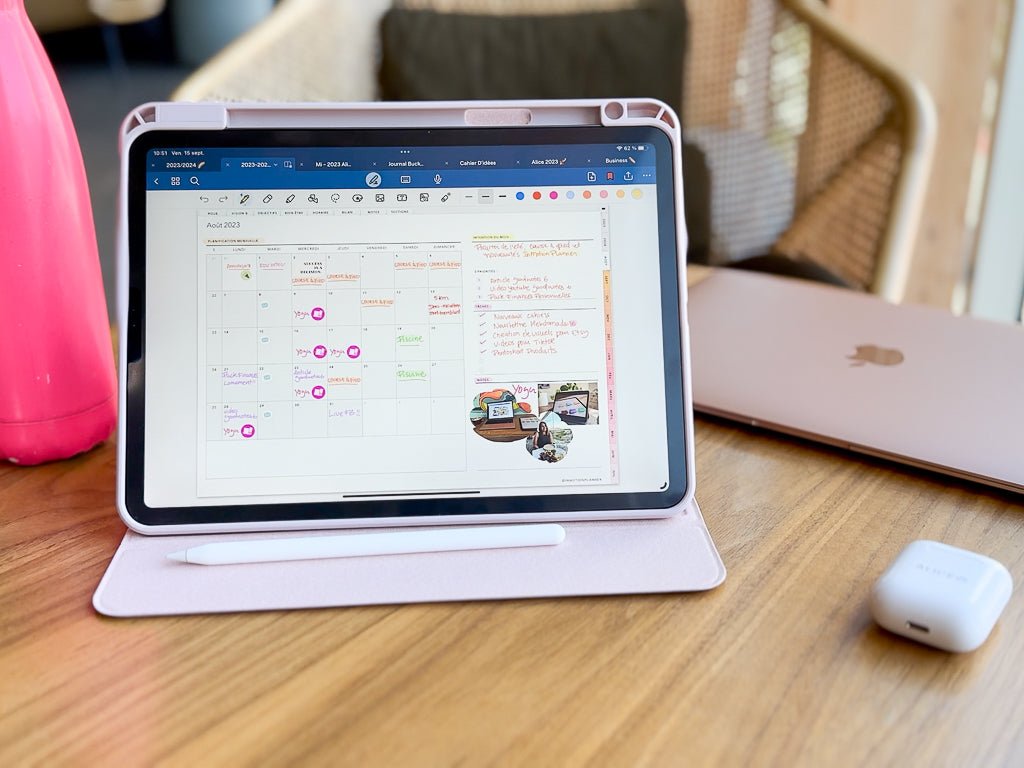
Between productivity and handwritten notes, it's hard to know which tool to choose to organize your daily life: digital planner or Notion?
Both promise to simplify your time management and boost your productivity, but they work very differently. The digital planner mimics the paper experience while offering the flexibility of digital: ideal for intuitive and handwritten planning. Notion, on the other hand, is an all-in-one platform designed to structure complex projects, centralize information, and collaborate.
Rather than opposing these two productivity tools, let's explore their respective strengths to understand which one matches your organizational style, and how to combine them for optimal productivity.
Digital Planner and Notion: Definitions and Key Uses
The Digital Planner: An Interactive Digital Notebook
A digital planner is an interactive agenda designed to be used on a tablet with applications like Goodnotes, Notability, or Noteshelf. It reproduces the appearance and features of a paper agenda, with hyperlinks allowing easy navigation between pages and sections. It allows you to take handwritten notes, highlight, add stickers, and fully customize the organizational experience.
Notion: A Modular Workspace
Notion is a no-code productivity application that combines note-taking, project management, and databases. It works on the principle of blocks: each element (task, note, table, checklist, etc.) can be modified and moved at will. Used by individuals and businesses alike, Notion allows you to create a personalized and ultra-flexible workspace. Its main asset: its ability to structure large amounts of information in a visual and connected way.
Advantages and Disadvantages of the Digital Planner

The digital planner is a modern alternative to the paper agenda, combining the flexibility of digital with the pleasure of handwritten organization. It appeals to those looking for visual and interactive planning, but it also has some limitations. Let's look at its main strengths and challenges.
Its advantages:
-
An immersive writing experience
The digital planner allows you to rediscover the pleasure of writing by hand while benefiting from the advantages of digital. Handwriting promotes memorization and reflection, and offers a more intuitive approach to planning. -
A visually engaging tool
Thanks to integrated hyperlinks, digital stickers, and customizable templates, the digital planner offers a more pleasant and stimulating experience. It encourages you to organize your days creatively. -
Total flexibility
Unlike paper, it has no page limits and can be modified at will. You can add sections, reorganize your priorities, and easily find your old notes thanks to search options.
Its challenges:
-
Reliance on tablet and stylus
To fully enjoy a digital planner, you need a tablet and a compatible stylus. This represents a significant initial cost compared to a simple paper notebook. -
Less integration with other tools
Unlike Notion, a digital planner remains a personal and static planning tool. It does not allow for automating certain tasks or collaborating with other people. -
Can be time-consuming
With all the customization options available, it's easy to spend more time beautifying your planner than actually organizing your days.
Advantages and Disadvantages of Notion

Notion has established itself as an essential productivity tool thanks to its flexibility and numerous features. It is ideal for structuring complex information and collaborating effectively, but it can also present some adaptation challenges. Let's examine its strengths and limitations.
Its strengths:
-
Ultra-flexible organization
Notion adapts to all needs. Whether you want to manage a project, track your finances, or organize your notes, you can create custom dashboards and databases. -
Seamless integration with other tools
It allows you to import documents, integrate links, and synchronize information with third-party applications (Google Calendar, Slack, Trello, etc.), making information management more fluid. -
A powerful collaborative tool
Unlike the digital planner, Notion is ideal for teamwork. It allows you to share notes, assign tasks, and track project progress in real time. -
Accessible on all devices
Whether you're on a computer, tablet, or smartphone, your data is always accessible, and everything syncs automatically.
Its limitations:
-
A learning curve that takes time
Notion is extremely modular, but this flexibility can also be a hindrance at first. It takes some time to properly organize your space and master all its features. -
Less intuitive for handwritten notes
Unlike the digital planner, Notion does not allow for handwriting. Those who prefer a handwritten approach might find it less natural. -
Reliance on an Internet connection
Notion primarily works online. Although it has an offline mode, it is limited and can be problematic if you need to access your information without a connection.
How to Combine Digital Planner and Notion for Optimal Organization?
Rather than choosing between these two tools, why not use them together to leverage their respective strengths?
Use the digital planner for creative planning
- Take handwritten notes and structure your days.
- Track your habits, goals, and personal priorities.
- Create an inspiring visual space for better motivation.
Notion for collaborative tracking
- Centralize professional and personal information.
- Track complex projects with dynamic databases.
- Automate certain tasks and collaborate with others.
The Real Choice: Not One Against the Other, But One For the Other

The digital planner and Notion are not rivals. They are two tools that meet different needs: one helps you reflect and plan your week with intention, the other helps you structure and track complex projects.
If you like to write by hand and keep a simple overview of your week, the digital planner is for you. If you manage multiple projects or work in a team, Notion will be your best ally.
And if you want the best of both worlds, combine them: Notion to centralize information, your digital planner to transform it into concrete actions, week after week.
At InMotion Planner, this philosophy guides the design of our planners: simple, intentional, and designed to help you take action, not just organize.
Browse our collection of digital planners and journals, or consult our complete guide to choosing the best one if you are still hesitant between models.